 (1).png "JR Immigration Consultants")
Spouse vs Dependent Visa – Eligibility, Work Rights & PR Guide
Planning to move abroad with your partner or family? Among the most perplexing issues for applicants is whether to apply for a spouse visa or a dependent visa. However, even though both enable family members to reside together abroad, the regulations, advantages, permission to work, and opportunities for long-term immigration may be vastly different.
Choosing the incorrect visa can affect your ability to work, study, extend your stay, or even apply for permanent residency down the road. Some visas provide full work rights, others have certain limitations, which the majority of applicants discover once they have moved abroad.
Spouse and dependent visa policies are still changing in 2026 in countries such as Canada, Australia, the UK, and the USA, so it is more important than ever to know which option suits your circumstances.
Introduction to Spouse & Dependent Visas
Relocating to another country is a significant life choice, but making it without your family can feel like you're missing something. That’s the point of spouse and dependent visas: to keep families together as they make a new life across the globe.
What are Spouse Visas?
A spouse visa is a type of family-based immigration visa that permits a legally married couple to live together in one spouse's home country. It is usually granted to the husband or wife of a citizen, permanent resident, or valid visa holder for family reunification. In several countries, spouse visas also allow the partners to work, study, and become permanent residents.
Who Can Apply for a Spouse Visa?
In general, couples that are legally married can apply for a spouse visa when one of them is a citizen or permanent resident of the country, or in the case that the individual who does not need a visa for the destination is the one holding a valid long-term visa. Applicants are generally required to submit evidence of marriage, financial support, identity documents, and proof that the relationship is genuine.
Eligibility for a Spouse Visa
Requirements for spouse visa applicants are generally as follows:
- Be legally married to a U.S. citizen/permanent resident/valid visa holder
- Present an authentic marriage certificate
- Demonstrate that the couple is truly and continues to be together
- Meet the minimum financial or sponsor requirements
- Provide documents for identity, health, and background checks
- Comply with immigration requirements specific to the country.
What are Dependent Visas?
The Dependent visa is designed to keep the family intact. When a person relocates to another country for work or study, they need not abandon their family. The visa enables close family members, usually a spouse, children, and in some cases parents, to join the main holder of the visa in a foreign country. Think of it as the “plus family” version of an international work or study permit.
Who Qualifies as a Dependent?
A dependent is generally one of the following:
- Spouse or equivalent partner.
- Unmarried children (typically under 18 or 21 as per country specifics).
- Under certain circumstances, mothers and fathers or other relatives may become dependents.
Eligibility for a Dependent Visa
Applicants for a dependent visa typically have to:
- Be financially dependent on the holder of the principal visa
- Submit evidence of the relationship, e.g. birth or marriage certificates
- Satisfy health and character criteria
- Show sufficient financial support from the sponsor
- For a qualifying main visa category
Common Countries Offering Dependent Visa Options
Popular locations that provide spouse and dependent visa routes are:
- Canada
- United Kingdom
- Australia
- United States
Spouse Visa vs Dependent Visa: Key Differences
Although spouse visas and dependent visas are both designed for family members, they differ in eligibility, legal status, work rights, and immigration benefits.
| Feature | Spouse Visa | Dependent Visa |
| Purpose | Issued specifically for a legally married husband or wife | Issued for family members dependent on the primary visa holder |
| Eligible Applicants | Married spouse of a citizen, PR holder, or visa holder | Spouse, children, or sometimes parents |
| Relationship Requirement | Legal marriage is usually mandatory | Family dependency proof required |
| Work Rights | Often allows full-time work in many countries | Work rights may be limited or restricted |
| Study Permission | Usually allowed | Depends on the country and visa type |
| Permanent Residency Pathway | Stronger PR and settlement opportunities | Limited or indirect PR pathway in some countries |
| Sponsor Requirement | Sponsored by spouse | Sponsored by the primary visa holder |
| Validity Period | Based on the spouse’s immigration status | Linked to the main visa holder’s validity |
| Financial Requirement | Often, strict financial proof is required | Depends on the sponsor’s income and visa category |
| Common Applicants | Married couples planning to settle together | Families accompanying students or workers |
Common Documents Required
Some commonly required documents include:
- Passport and identity proof
- Marriage certificate or birth certificate
- Financial statements and sponsorship documents
- Medical examination reports
- Police clearance certificates
- Visa application forms and photographs
Application Process for Spouse and Dependent Visas
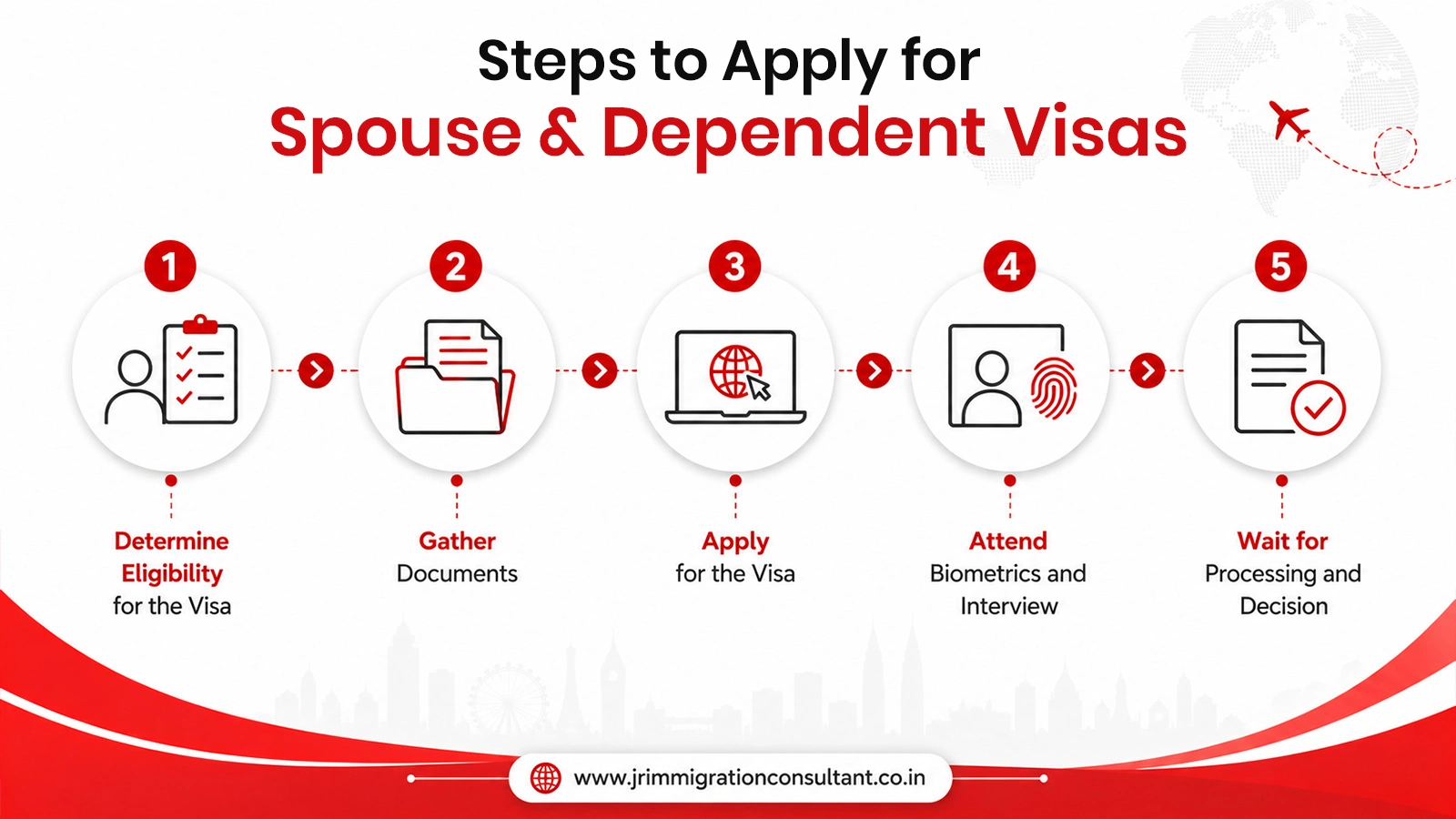
The application process for spouse and dependent visas usually involves submitting relationship proof, financial documents, and immigration forms to the respective country’s visa authority.
Step 1: Determine Eligibility for the Visa
Applicants should check their eligibility for a spouse visa or a dependent visa before applying based on their relationship status, the sponsor's eligibility, and the immigration class.
Step 2: Gather Documents
You typically need to make preparations for the following:
- Valid passports
- Marriage / birth certificates
- Sponsorship documents and financial proofs
- Medical and police clearances
- Visa application forms and photographs
Step 3: Apply for the Visa
Applications can normally be made online or via official visa application centres. Applicants must complete all forms accurately and upload supporting documents; otherwise, their application may be delayed or rejected.
Step 4: Attend Biometrics and Interview
A large number of countries require biometric data, such as fingerprints and a photograph. Applicants might also be required to go to a visa interview to confirm the authenticity of the relationship and the intent to immigrate.
Step 5: Wait for Processing and Decision
Processing times for visas are dependent on consulate input load, the visa type, and security checks of documents. The authorities may ask for additional documents prior to deciding.
Conclusion
Being able to join your family in a new country is the highlight of a moving experience, not the source of anxiety, misinformation, and waiting. Spouse and dependent visas are complex and require documentation, strict rules, and careful planning, and therefore, the right advice can make all the difference.
With professional guidance, you can steer clear of typical errors, be up-to-date with immigration policies, and increase your probability of getting approved greatly.
If you want dependable help, platforms such as www.jrimmigrationconsultant.co.in provide family visa application support, which you can use to help you through the process with confidence and peace of mind. Your trip overseas is far more streamlined if you have seasoned professionals leading you along the way.